
Table of Contents
ToggleMost homeowners shop for a solar generator by sorting on capacity, assuming more watt-hours means better protection. Capacity is actually the third specification to evaluate, not the first. This guide covers the four criteria that determine whether a solar generator fits your home, in the order that matters.
What Makes Home Backup Power Different from Other Solar Generator Use Cases?
Home backup has three requirements that separate it from camping or RV use.
Appliance starting capability. Home backup almost always involves at least one motor-driven appliance: a refrigerator, sump pump, window air conditioner, or medical device with a compressor. These have starting wattage requirements two to four times their running wattage. A generator selected without checking surge wattage will fail to start them.
Extended runtime. Camping trips involve one to two days of power management. Home outages caused by hurricanes or ice storms routinely last 48 to 96 hours. A generator sized for an overnight does not cover the realistic worst case.
Long-term reliability. A home backup unit sits in one place for years and may cycle through hundreds of charges. Portability matters less than battery chemistry, cycle life, and expandability.
Which Four Specifications Actually Determine Whether a Solar Generator Fits Your Home?
These four specifications, evaluated in the order presented, determine whether a solar generator can actually serve your home backup needs. Each one addresses a different binding constraint.
1. Surge Wattage
Surge wattage, also called peak output, is the maximum power the generator can deliver for the brief interval required to start a motor-driven appliance. It is typically two to three times the continuous output rating.
The practical check is straightforward. Identify the appliance in your home with the highest starting wattage requirement. This is typically a refrigerator (700 to 1,200 watts to start), a window air conditioner (1,500 to 3,500 watts to start depending on BTU rating), or a sump pump (1,500 to 2,500 watts to start). The generator’s surge wattage must exceed this figure. If it does not, that appliance will not start, and the generator’s storage capacity becomes irrelevant for that use case.
The EcoFlow DELTA Pro 3 delivers 8,000 watts of surge output. The DELTA 3 Max delivers 5,000 watts. For most single-family homes running a refrigerator, lighting, and communication devices as the primary backup load, 5,000 watts of surge capacity is sufficient. Adding a window air conditioner to the required load set pushes the surge requirement above 3,500 watts for most units, which both of those models handle comfortably.
2. Continuous AC Output Wattage
Continuous output wattage determines which combination of appliances you can run simultaneously during an outage. Unlike surge wattage, this figure represents sustained delivery, not a momentary peak.
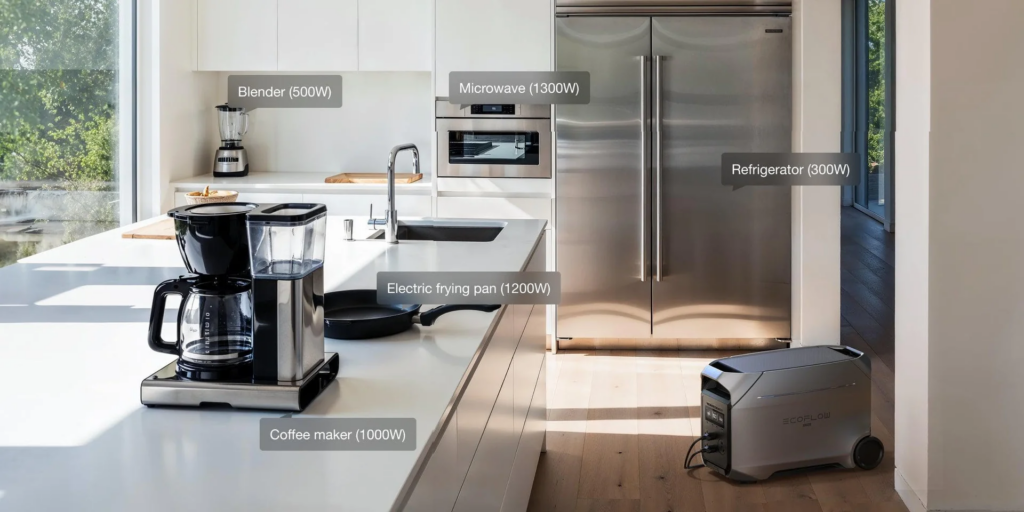
To find your minimum continuous output requirement, add the running wattage of every appliance you plan to operate at the same time. A refrigerator running at 150 watts, ten LED lights at 60 watts combined, a router and modem at 20 watts, two phone chargers at 30 watts, and a CPAP machine at 50 watts produces a combined running draw of 310 watts. That load is within the continuous output range of any mid-range solar generator on the market.
Adding a window air conditioner at 500 watts running brings the total to 810 watts. Adding a small electric space heater at 750 watts brings it to 1,560 watts. These loads remain within the 1,800 to 2,400 watt continuous output range of mid-tier generators.
The scenarios that stress continuous output limits involve multiple high-wattage appliances operating simultaneously. An air conditioner, a microwave, and a hair dryer running at the same time can easily reach 3,000 to 4,000 watts combined. The DELTA Pro 3’s 4,000 watts of continuous AC output handles this combination. Smaller units in the 1,800-watt continuous output range cannot.
3. Battery Capacity
Capacity, measured in watt-hours, determines how long you can run your loads before the battery requires recharging. This is the specification most buyers evaluate first, but it belongs third on the priority list because it is only meaningful after the previous two constraints are satisfied.
The calculation is direct: multiply each appliance’s running wattage by its expected daily hours of use, then sum the results. A household running a refrigerator continuously (150W times 24 hours equals 3,600 Wh), LED lighting for six hours (60W times 6 hours equals 360 Wh), a router for 24 hours (20W times 24 hours equals 480 Wh), and phone charging for four hours (30W times 4 hours equals 120 Wh) consumes approximately 4,560 watt-hours per day for critical loads.
A generator with 4,000 Wh of storage covers approximately 21 hours of this load without recharge. A generator with 8,000 Wh covers approximately 42 hours. For a 48-hour outage without solar input, target storage capacity that approaches or exceeds your daily consumption multiplied by two.
4. Solar Input Capacity
Solar input capacity, expressed as maximum watts of PV input, determines how quickly the battery recharges from solar panels and whether the system can sustain your daily consumption indefinitely rather than drawing down a finite reserve.
For outages lasting under 24 hours, solar input is a secondary concern. The stored capacity is what carries you through. For outages lasting 48 hours or more, solar input becomes the critical variable. A system that generates less daily energy from solar than it consumes daily will eventually deplete, regardless of how large the initial battery is.
The calculation works in reverse from the capacity calculation. Take your daily critical load consumption in watt-hours. Divide by your location’s average peak sun hours. Apply a 75 to 80 percent real-world efficiency factor. The result is the minimum solar panel wattage required to offset daily consumption in average conditions.
For the household in the example above consuming 4,560 watt-hours daily, in a location averaging five peak sun hours, the calculation is 4,560 divided by 5 divided by 0.77, which equals approximately 1,185 watts of solar panel capacity needed to break even on daily consumption. Two 600-watt panels, or four 400-watt panels, would achieve this. The DELTA Pro 3 supports up to 2,600 watts of solar input, which comfortably accommodates this configuration.
The table below summarizes when each specification is the binding constraint.
|
Specification |
Determines |
Priority for Short Outages |
Priority for Extended Outages |
|
Surge wattage |
Which appliances can start |
High |
High |
|
Continuous output |
Which appliances run simultaneously |
High |
High |
|
Battery capacity |
How long without recharge |
High |
Medium |
|
Solar input |
Long-term self-sufficiency |
Low |
High |
How Do You Calculate the Right Capacity for Your Household?
Rather than working through a detailed load calculation from scratch, the most practical approach for home backup selection is to identify which of three household profiles most closely matches your situation and use the corresponding capacity range as your starting point.
|
Household Type |
Critical Loads |
Daily Consumption |
Starting Capacity |
|
Small home, essential needs only |
Refrigerator, lighting, phones, router |
1,500 to 2,500 Wh |
2,000 to 3,000 Wh |
|
Mid-size home, includes medical devices |
Above plus CPAP, small heater or fan |
2,500 to 4,000 Wh |
3,500 to 5,000 Wh |
|
Larger home, includes air conditioning |
Above plus window AC intermittently |
5,000 to 8,000 Wh |
6,000 Wh and above with solar |
These ranges assume one to two days of runtime without solar recharge. Households in regions where multi-day outages are common, such as hurricane-prone coastal areas or northern states with severe winter storm exposure, should target the upper end of each range or invest in expandable capacity.
Why Does Battery Chemistry Matter When Choosing a Home Backup Solar Generator?
Battery chemistry affects three practical outcomes for home backup users: how many times the battery can be charged before capacity degrades, how safely it handles high temperatures, and what it costs to own over a ten-year period.
The two chemistries present in consumer solar generators are lithium iron phosphate, commonly labeled LFP, and lithium nickel manganese cobalt oxide, commonly labeled NMC.
|
Dimension |
LFP |
NMC |
|
Cycle life before 80% capacity |
3,000 to 6,000 cycles |
500 to 1,000 cycles |
|
Thermal stability |
High, resistant to thermal runaway |
Lower, requires more active management |
|
Energy density |
Lower (heavier for same capacity) |
Higher (lighter for same capacity) |
|
10-year replacement cost |
Low to none |
Often requires one replacement |
|
Home backup suitability |
High |
Moderate |
For home backup, LFP is the right choice. The unit stays in one place, so weight is not a constraint. It cycles hundreds of times per year, so longevity matters. It may sit in a warm garage, so thermal stability is a safety consideration. EcoFlow’s full lineup uses LFP cells rated for 3,500 cycles before reaching 80 percent of original capacity, which translates to close to ten years of daily use.
Why Should Expandability Factor into Your Buying Decision?
Most buyers select based on current needs. The more useful framing is where those needs will be in three to five years. Families grow. Home offices become permanent. A worse-than-expected outage reveals that the original system was undersized.
Expandable systems accept additional battery modules and more solar panels without replacing the base unit. The EcoFlow DELTA Pro series supports bolt-on Extra Batteries that integrate as seamless additional capacity. The DELTA Pro Ultra scales to 90 kWh through a modular architecture. When evaluating any unit, confirm that compatible expansion batteries exist for that specific model and check the maximum expandable capacity ceiling. Paying a modest premium for expandability at purchase costs significantly less than replacing the unit when needs grow.
What Are the Most Common Mistakes Homeowners Make When Choosing a Solar Generator for Backup Power?
Evaluating capacity before surge wattage. This is the single most common source of post-purchase regret in this category. A generator that cannot start your refrigerator has failed its primary job, regardless of how many watt-hours it stores. Always confirm surge wattage against your highest starting-load appliance before reading any other specification.
Sizing to current needs with no margin for growth. A generator that precisely covers today’s critical loads has no buffer for an additional appliance, a new household member, or a more severe outage than the one originally planned for. Targeting one step above current needs costs less at purchase time than replacing the unit in two years.
Selecting a camping or outdoor-optimized unit for permanent home backup use. Products designed for portability optimize for low weight and compact size. Their continuous output ratings and thermal management are designed for intermittent light use rather than sustained heavy loads. A unit rated for adequate output in occasional outdoor use may throttle output or trigger thermal protection during the sustained high-load conditions of a multi-day home backup scenario.
Treating the solar generator as a standalone battery rather than as part of a solar charging system. A solar generator without solar panels depends entirely on grid charging between uses. During a regional outage that lasts several days, grid charging is unavailable by definition. Without solar input, a finite battery becomes a countdown timer rather than a sustainable system.
Anchoring to price before establishing the specification floor. Shopping by price first leads to evaluating whether a lower-cost unit is “good enough” rather than starting from what you actually need and finding the most cost-effective product that meets that standard. The correct sequence is needs assessment, specification floor, then price comparison within the qualifying set.
Frequently Asked Questions
What size solar generator do I need for a 2,000 square foot home?
Home size is not the most useful variable. The relevant variable is your critical load list. A 2,000 square foot home with gas heating, a standard refrigerator, LED lighting, and basic communication devices has a daily critical load in the 2,000 to 3,000 watt-hour range, well within the capacity of a DELTA 3 Max or similar mid-range unit. The same home with electric heating or central air conditioning as a required backup load has a daily critical load in the 6,000 to 10,000 watt-hour range, which requires a DELTA Pro tier system. Square footage predicts almost nothing. The appliance list predicts everything.
Can a solar generator power a refrigerator for 24 hours?
Yes, in most configurations. A standard full-size refrigerator consumes approximately 100 to 200 watts while running and cycles on and off throughout the day, using approximately 1,000 to 1,500 watt-hours over 24 hours. A 2,000 Wh generator dedicated to refrigerator use lasts 13 to 20 hours before recharge. Adding a 400W solar panel that generates 1,600 to 2,000 watt-hours on a clear day makes the system capable of running a refrigerator indefinitely in good solar conditions. Confirm that the generator’s surge wattage exceeds your refrigerator’s starting wattage before purchasing.
How long does it take to charge a solar generator with solar panels?
Charging time depends on battery capacity, solar panel wattage, and available sunlight. A 2,000 Wh battery connected to a 400W solar panel in five peak sun hours of direct sunlight receives approximately 1,600 to 2,000 watt-hours, which is a near-full recharge from empty in one clear day. A 4,000 Wh battery under the same conditions reaches 40 to 50 percent charge in one day and full charge in two days. Increasing solar panel wattage proportionally reduces charging time. EcoFlow generators support multiple solar panels connected simultaneously up to the maximum rated solar input, which allows significantly faster charging on systems with that capacity.
Is a 2,000 Wh solar generator enough for home backup?
For a small household running essential loads only, a 2,000 Wh generator provides meaningful backup coverage. It sustains a refrigerator, lights, router, and phone charging for approximately 12 to 18 hours without recharge. With solar input, it can sustain those loads indefinitely in average conditions. It is not sufficient for households that need to include air conditioning, electric heating, or medical equipment with high wattage requirements in their backup load set. Those scenarios require 4,000 Wh and above.
What is the difference between a solar generator and a home battery system like Tesla Powerwall?
A home battery system like the Powerwall is a fixed installation that connects to your home’s electrical panel through a transfer switch and charges from rooftop solar panels or the grid. It powers your home’s circuits automatically when the grid goes down, without any manual setup. The Powerwall 3 stores 13.5 kWh and integrates with a dedicated solar installation. A portable solar generator like the EcoFlow DELTA Pro 3 stores 4 kWh expandable to larger capacities, does not require professional installation or electrical panel integration, and powers devices via direct plug-in connection rather than whole-home circuits. The Powerwall is the right choice for homeowners with existing or planned rooftop solar who want seamless whole-home coverage. A portable solar generator is the right choice for homeowners who want meaningful backup capability without a fixed installation commitment, or who want a system that can also serve portable and off-grid uses beyond home backup.
Conclusion
Evaluate surge wattage first, continuous output second, capacity third, and solar input fourth. That order reflects the sequence in which each specification becomes a binding constraint in actual use, and it produces a purchase that performs when the grid goes down.
EcoFlow’s DELTA 3 Max covers essential household loads, the DELTA Pro 3 covers mid-to-large homes with room to expand, and the DELTA Pro Ultra covers whole-home coverage with long-term energy independence. All three use LFP batteries and support solar input from day one. Start with your appliance list and the surge wattage floor. Everything else follows.