
Table of Contents
ToggleEvery time a motor spins, a conveyor moves, or a machine arm shifts position, something small and precise makes it possible. That something is a bearing. Yet for many procurement teams, bearings are an afterthought until a line goes down or a replacement order goes wrong.
Getting bearing procurement right saves money, reduces downtime, and keeps equipment running longer. This guide walks you through what bearings are, how they work, and what to look for when sourcing them.
What Are Industrial Bearings and Why Do They Matter?
A bearing is a mechanical component that supports a load while allowing controlled movement between two parts. It reduces friction between moving surfaces, which protects equipment and improves efficiency.
Without bearings, rotating shafts and moving components would wear down rapidly. Bearings distribute load, reduce heat buildup, and extend the service life of machinery across virtually every industry.
How Do Bearings Work in Machinery?
Bearings work by placing rolling elements between two surfaces: the inner race and the outer race. As one surface moves, the rolling elements rotate between them, reducing direct contact and minimizing friction.
The type of rolling element, the geometry of the races, and the bearing’s internal clearance all determine how much load it handles and at what speeds. Different applications demand different configurations.
Key Industrial Bearing Components and Their Function
Understanding the basic parts helps you evaluate specifications more accurately. A standard rolling element bearing includes:
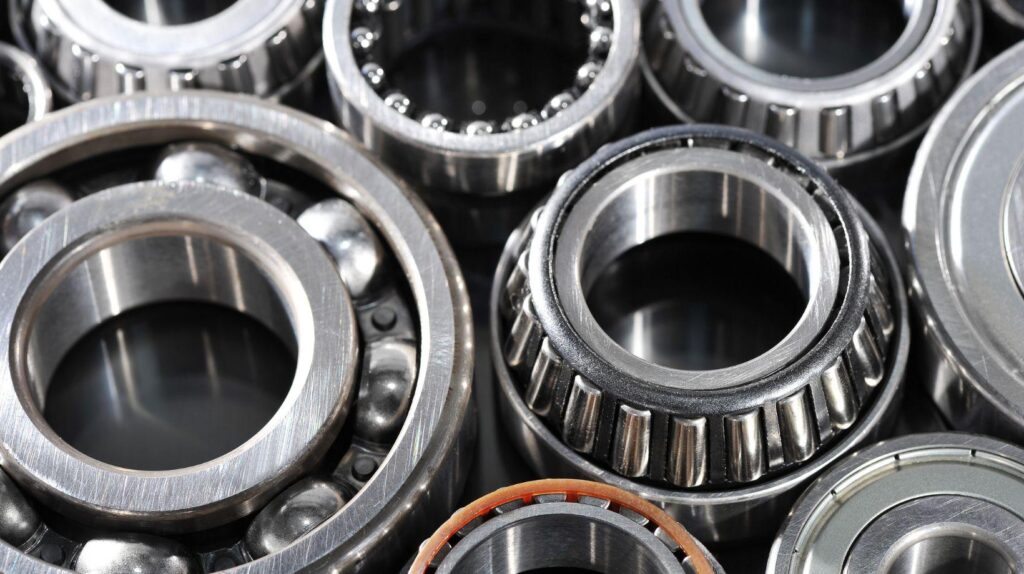
Inner race: the ring that fits onto the rotating shaft Outer race: the fixed ring seated in the housing Rolling elements: balls or rollers that sit between the races Cage: holds the rolling elements evenly spaced Seals or shields: protect internal components from contaminants
Each part affects performance. Seal type, for instance, influences lubrication intervals and suitability for harsh environments.
Industrial Bearing Classification: The Main Categories Explained
Bearings are grouped by the type of motion they support and the direction of the load they carry. Understanding this classification system is foundational to sourcing the right component.
Ball Bearings: Types, Uses, and Load Capabilities
Ball bearings use spherical rolling elements. They perform well under moderate radial loads and high speeds. Common subtypes include deep groove ball bearings, angular contact bearings, and thrust ball bearings.
Deep groove ball bearings are the most widely used type across industries. They handle both radial and axial loads, making them a practical choice for electric motors, pumps, and gearboxes.
When your application involves high-speed rotation with light to moderate loads, ball bearings are often the right starting point.
Roller Bearings: Applications and When to Use Them
Roller bearings use cylindrical, tapered, spherical, or needle-shaped rolling elements. The larger contact area gives them higher load capacity compared to ball bearings.
Tapered roller bearings handle combined radial and axial loads. They are common in automotive wheel hubs and heavy industrial gearboxes. Spherical roller bearings accommodate misalignment, making them suitable for mining and paper mill equipment.
If your machinery operates under heavy or shock loads, roller bearings are the stronger option.
Linear Bearings: A Guide for Motion and Positioning Applications
Linear bearings support straight-line motion rather than rotational movement. They are standard components in CNC machines, 3D printers, packaging equipment, and automated assembly systems.
Linear ball bearings use recirculating ball elements inside a sleeve. Linear roller bearings offer higher rigidity for precision positioning. Choosing between them depends on the required accuracy, load, and travel speed of your application.
Bearing Materials and Construction: What Procurement Teams Should Know
Material selection directly affects a bearing’s durability, operating range, and total cost. Chrome steel is the industry standard. It offers a strong balance of hardness and fatigue resistance at an accessible price point.
Stainless steel suits environments with moisture or mild chemical exposure. Ceramic hybrid bearings use steel races with ceramic rolling elements. They run cooler, resist corrosion, and perform at higher speeds, but they come at a higher cost.
Seals and shields are equally important. Open bearings allow for re-lubrication in the field. Shielded bearings (ZZ) provide basic protection from debris. Sealed bearings (2RS) are pre-lubricated and fully enclosed, reducing maintenance requirements in difficult-to-access locations.
When sourcing bearings online through a bearings store, confirm that the material, internal clearance, and sealing configuration match the application before placing a bulk order.
Heavy Duty Bearing Specifications: What the Numbers Actually Mean
Bearing specification codes follow international standards. Once you know how to read them, sourcing becomes faster and more accurate.
The dynamic load rating (C) tells you the load a bearing handles for one million revolutions. The static load rating (C0) applies when the bearing is stationary or moving slowly.
ABEC grades (1 through 9) define dimensional tolerances and running accuracy. Higher grades suit precision instruments and high-speed spindles. Standard ABEC 1 or 3 bearings work for most general industrial applications and offer better value for bulk procurement.
The Procurement Team’s Buying Guide to Industrial Bearings
Before you finalize any order, confirm these factors with your supplier:
Minimum order quantities and lead times ISO 9001 certification or equivalent quality standards Part number cross-referencing for interchangeability Traceability documentation for critical applications Packaging and storage conditions for long-shelf-life stock
If you source bulk ball bearings for high-volume production environments, consistency across batches matters as much as unit price. Request samples before committing to large orders.
Common Procurement Mistakes When Sourcing Industrial Bearings
Over-specifying is one of the most frequent errors. Ordering a precision-grade bearing when a standard grade performs the same function increases cost without improving outcomes.
Ignoring lead times is another common issue. Specialty bearings and non-standard sizes often require longer procurement windows. Build that timeline into your maintenance planning.
Finally, price alone should not drive bearing selection. Counterfeit or substandard bearings may appear identical but fail early, causing equipment damage that far exceeds the initial savings.
Which Types of Industrial Bearings Are Right for Your Application?
The right bearing depends on three factors: load type and direction, operating speed, and environmental conditions. Matching all three to the correct bearing type and material reduces failure rates and total cost of ownership like the bearings that Online Bearing Store has.
Start with the load. Radial loads point outward from the shaft. Axial loads run parallel to it. Combined loads require bearings engineered for both. From there, narrow your options by speed, temperature range, and contamination risk.
Work with a qualified distributor who provides full specifications, certifications, and technical support. The right sourcing partner makes the selection process faster and reduces the risk of costly errors in the field.