
Table of Contents
TogglePeople will repaint a bedroom to make it feel fresh. They’ll change the curtains, swap the rug, buy new bedding in a lighter colour. All of it visible, all of it costing real money.
Then they’ll sleep for eight hours a night, face down, on a surface that hasn’t been properly cleaned since it was delivered nine years ago.
Your mattress is the single largest textile object in your home. It’s the one you have the most direct physical contact with, by a wide margin, and it’s the only major furnishing that gets excluded from every cleaning routine on the grounds that it’s covered by a sheet. The sheet is not doing what you think it’s doing.
What is actually in there
Let’s do this quickly, because it’s unpleasant and you don’t need it dwelt on.
An adult sheds skin cells continuously and loses somewhere around half a litre of moisture a night through perspiration and respiration. Most of that passes through the sheet. Some of it stays.
Skin and moisture together are the complete life-support system for dust mites, which don’t bite, don’t carry disease, and are irrelevant to most people. Their waste is the problem. It contains proteins that are among the most common triggers of perennial allergic rhinitis and asthma, and the Asthma and Allergy Foundation of America ranks dust mite allergy among the most widespread indoor allergies there is. Bedding is the primary reservoir. Not carpets, not curtains. The bed.
Add to that whatever the mattress has absorbed over the years: sweat, body oils, spilled drinks, the occasional child-related incident, and in humid climates enough retained moisture to support fungal growth deeper in the foam where nothing dries out properly.
None of this is visible. That’s the whole difficulty. A mattress can look completely fine and be a substantial load on the air in a room where you spend a third of your life breathing slowly and deeply.
The air quality argument, honestly stated
I want to be careful here, because this topic attracts a lot of exaggeration and the actual case is strong enough without it.
Your mattress does not poison you. It is not, in most homes, the largest single influence on indoor air quality. The EPA’s indoor air quality resources put ventilation, combustion sources, and chemical products well up the list of things that matter.
What a mattress does is more specific and, for a certain group of people, more consequential. It is a concentrated allergen reservoir positioned directly under your face for eight hours, and it gets mechanically agitated every time you move. Particles get released into the breathing zone at exactly the moment you’re least able to leave the room.
So the effect isn’t general. It’s targeted. If nobody in the house has respiratory symptoms, this is a hygiene matter and not much more. If someone wakes up congested, sneezes for the first twenty minutes of the day, or has asthma that reliably worsens overnight, the bed is a legitimate suspect and the American Academy of Allergy, Asthma and Immunology puts bedroom allergen control near the front of its environmental control advice for good reason.
That morning pattern is the diagnostic tell. Symptoms strongest on waking, easing through the day, worse again after a night at home. It points at the sleeping surface more reliably than anything else.
Why vacuuming it doesn’t do the job
Running the upholstery attachment over the top of a mattress is better than nothing, and it is not deep cleaning.
Two reasons. The allergens are not sitting loose on the surface, they’re embedded within the top few centimetres of fibre and foam. And a standard domestic vacuum without proper filtration will pick up fine particulate at one end and blow a good proportion of it back into the room at the other, which is an efficient way to convert a settled problem into an airborne one.
Steam is the other DIY approach and it carries a real risk. Memory foam and latex hold moisture, they dry from the outside in, and a mattress that’s been steamed enthusiastically at home can stay damp internally for days. You have then built exactly the conditions for mould in the middle of your bed, which is a considerably worse outcome than the one you were solving.
Professional treatment uses hot water extraction or dry-compound methods with controlled moisture and proper extraction, plus HEPA-filtered equipment that captures particulate instead of redistributing it. In humid regions the drying control is the part that matters most. Services like mattress cleaning Dubai exist largely because the climate makes the DIY route riskier than it is in temperate places, where a damp mattress will usually get away with it.
The ROI part, which is more real than it sounds
Three separate financial arguments, and the third is the one landlords care about.
Mattress life. A decent mattress is a four-figure purchase with a manufacturer-claimed lifespan of seven to ten years. Most get replaced early, and often not because the support has failed but because they’ve become unpleasant. Accumulated staining, retained odour, a general sense that it’s had its day. Cleaning on a sensible cycle pushes replacement back by years. The maths on that is straightforward and heavily favours cleaning.
Warranty. This one catches people out. A significant number of mattress warranties are void on visible staining, on the reasoning that a stain indicates misuse or unhygienic conditions. A support failure at year five that would have been covered becomes your problem because of a coffee spill in year two.
Property turnover. In furnished rentals, short-term lets, and serviced apartments, the mattress is the item guests judge most harshly and comment on most publicly. It’s also one of the few furnishings that can single-handedly generate a bad review. Compared with repainting or replacing furniture, deep cleaning is a trivial cost with a disproportionate effect on how a room reads to someone who has just walked in. Property managers who run a scheduled cleaning cycle across a portfolio tend to talk about it as the cheapest per-unit intervention they have.
A workable routine
Wash bedding weekly at 60°C, which is the temperature that actually kills mites rather than relocating them. Use a proper encasement protector, not a thin quilted pad, and wash that monthly. Vacuum the mattress surface every few weeks if your machine has HEPA filtration. Rotate as the manufacturer specifies. Keep bedroom humidity below about 50% where you can, since mites cannot survive dry air and this is the single most effective control available.
Deep clean professionally once a year in humid climates, every eighteen months to two years in dry ones, and sooner after illness, a spill, or a move.
Wrapping up
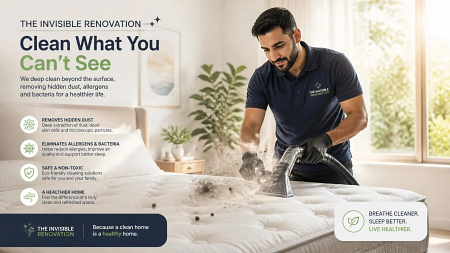
I call it an invisible renovation because that’s genuinely what it is. Nothing about the room looks different afterwards. There’s no before-and-after photo worth taking.
But you’ve improved the air in the space where you spend more consecutive hours than any other, extended the life of an expensive item, protected a warranty, and removed the most likely explanation for why someone in the house wakes up stuffy.
For less than the cost of the curtains you were thinking about replacing.