
Table of Contents
ToggleHow to verify real estate credentials and service areas matters the moment someone lists themselves as an agent or property manager. A single bad hire can cost tens of thousands in missed disclosures, mispriced offers, or legal fees. This guide gives a practical, step-by-step checklist for 2026 that helps readers confirm licenses, certifications, disciplinary records, and the actual neighborhoods an agent serves. It prioritizes public records, quick online checks, and the exact documents to request so hiring decisions rely on verifiable facts, not flattering profiles or slick marketing.
Key Takeaways
- Verifying real estate credentials and service areas is essential to avoid costly legal issues, ensure competence, and confirm local market expertise.
- Check state licensing boards first by using the agent’s full name and license number to confirm active status and broker affiliation.
- Confirm professional certifications through issuing organizations and review disciplinary records on state sites for complaints or suspensions.
- Assess an agent’s local knowledge by requesting recent closed sales in the target area, client references, and a detailed market activity report.
- Document all verification steps meticulously, including screenshots and copies of licenses, and cross-check online profiles against official state records.
- Spend 20–40 minutes on this verification process to make informed hiring decisions based on verifiable facts, not just marketing materials.
Why Verifying Credentials And Service Areas Matters
Fact up front: verifying credentials and service areas prevents costly mistakes and legal exposure. Buyers and sellers who skip checks risk working with someone without a valid license, with unresolved complaints, or who doesn’t actually work in the local market.
Verifying matters for three concrete reasons: legal compliance, competence, and market fit. Legally, real estate transactions require licensed professionals in most U.S. states: an invalid license can void a contract or trigger fines. Practically, certifications like Certified Residential Specialist or appraisal credentials indicate specialized training, they correlate with stronger performance in specific transaction types. Finally, an agent’s service area determines neighborhood knowledge: an agent who claims to serve “Greater Boston” may have no active listings in the precise ZIP code a buyer needs.
A real example: in 2024 a homeowner in Phoenix accepted an agent’s offer to list without checking the broker’s active license: after the sale, a state board found the broker’s license lapsed and the seller faced contract delays and a $3,600 penalty. That kind of risk is avoidable with a short verification checklist.
Step-By-Step: How To Verify Licenses, Certifications, And Disciplinary Records
Answer first: follow a short, repeatable sequence, check state license, confirm certifications, and review disciplinary history.
-
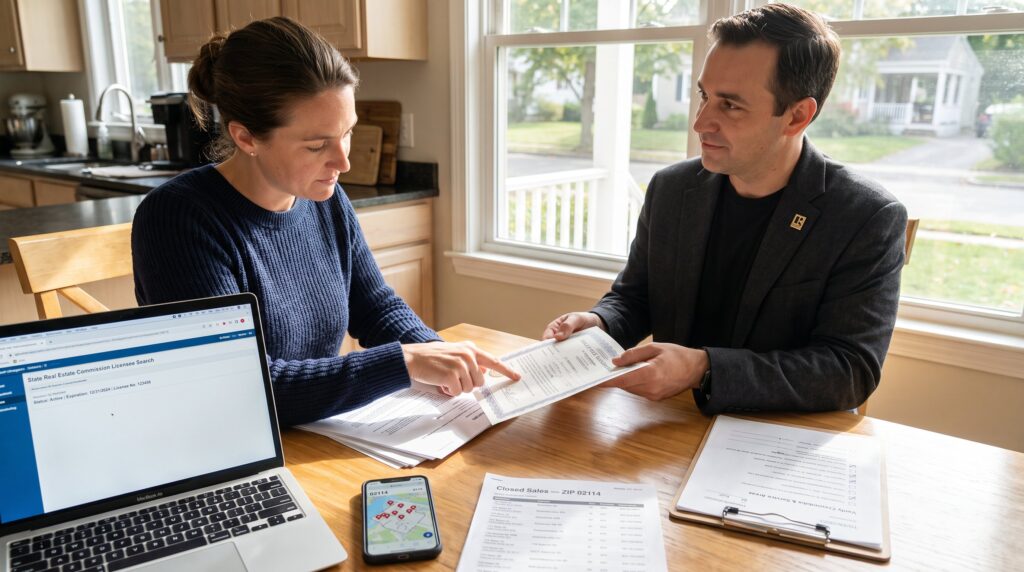
Check the state licensing board. Ask the agent for full name and license number, then search the appropriate state real estate commission database. These searches show active/inactive status, expiration dates, and the broker’s sponsoring firm. If the agent can’t provide a license number, treat that as a red flag.
-
Confirm professional certifications. Certifications matter when the transaction needs specialty skills (investments, luxury sales, appraisals). Contact issuing organizations (for example, the Council of Residential Specialists) or search their public registries. Many certifications list credential numbers and renewal dates.
-
Review disciplinary records. Most state boards publish complaints, fines, and suspensions. Search the state site’s disciplinary or enforcement section. If nothing appears, request a written statement from the agent affirming no disciplinary actions and compare it to the public record.
-
Document everything. Save screenshots of search results and request scanned copies of certificates and ID. Keep a short verification log with dates and who was contacted.
Practical tip: when a license search returns multiple people with the same name, verify using the license number or local office address. That prevents confusing one licensee with another.
Where To Check: State Databases, NAR Records, And Third-Party Verification Tools
Answer first: use primary sources first, state databases and NAR, then cross-check with vetted third-party tools.
State real estate commission sites are primary evidence. They list license status, license type (salesperson, broker, appraiser), issue and expiration dates, and enforcement actions. For multi-state agents, search each relevant state board. The Nationwide Multistate Licensing System (NMLS) is useful where applicable for some licensure types.
The National Association of Realtors (NAR) maintains membership records and can confirm Realtor® status. NAR membership signals adherence to a Code of Ethics, which matters in disputes. For specialty credentials, visit issuing bodies’ registries.
Third-party verification tools speed checks. Platforms used by brokerages aggregate state data and show red flags like expired E&O insurance or unresolved complaints. Use them to save time, but always capture original state pages as primary proof.
A practical resource note: the site’s pillar page about services helps users understand available tools and resources: it also maps where MasterRealtySolutions hosts its verification guides in context. See a short overview in the site resources section with the internal guide to services and resources linked for broader help: site resources overview.
When to use an external article: if the verification covers contractor-style licenses or trade checks, reliable consumer pages such as Bob Vila’s hiring guidance can supplement steps for vetting contractors in property repairs.
Confirming Service Areas, Market Experience, And Local Knowledge
Answer first: confirm service areas by active listings, sold-history, and area-specific references.
Start with active MLS listings and sold-history in the exact ZIP code or neighborhood. An agent who claims local expertise should have recent closed sales within the target area. Ask for a one-page market activity report showing listings and closings from the past 12 months. Confirm those entries in the public MLS or county recorder’s office when possible.
Request specific references: three recent clients who bought or sold in the same neighborhood within the prior year. Call or email at least two references and ask two targeted questions: “Did the agent counsel you on neighborhood comps?” and “Did they coordinate local inspections and contractors?” Real answers often include specifics, street names, inspection issues, or a local lender’s name.
Evaluate local knowledge with a short in-person or virtual walk-through. Ask the agent to point out three micro-market factors: typical days on market, common inspection issues, and local zoning quirks. An agent who answers with precise numbers and named streets shows true local experience: vague answers indicate they may not work the area regularly.
Internal resources on MasterRealtySolutions explain how to explore agency services and neighborhood tools: a focused page lists how to access market reports and local agent profiles for deeper checks: market tools overview.
Red Flags, Documentation To Request, And How To Verify Online Profiles
Answer first: watch for missing documents, inconsistent records, and curated online profiles without verifiable facts.
Red flags include: an agent who refuses to share a license number, conflicting license status across states, gaps in employment history, or reported disciplinary actions not disclosed. Also watch for inflated claims like “top producer” without sales volume specifics.
Documents to request: a copy of the broker’s current state license, proof of E&O insurance with policy numbers and effective dates, a list of closed transactions for the last 12 months with addresses, and written consent to contact references. For commercial or management roles, ask for relevant certifications and proof of bond where applicable.
Verifying online profiles: cross-check LinkedIn, Zillow, and brokerage pages against state records. If an agent lists a license number on Zillow, confirm that exact number in the state database. For large brokerages, firm directories should match the sponsoring broker listed on state sites. If social profiles show glowing testimonials but no documented closings nearby, press for transaction records.
Concrete example: one buyer found an agent with a polished profile showing 200+ sales: state records revealed only 18 closed transactions in five years. That mismatch led the buyer to request detailed lists and choose a different agent with verifiable local patience and performance.
For additional internal guidance about adapting services and features that support thorough vetting, consult the MasterRealtySolutions feature overview: service features. Also, a practical page on listings helps interpret sale data: listings guidance.
Conclusion
Final insight: verification is short, repeatable, and high-impact. Spend 20–40 minutes verifying licenses, certifications, disciplinary history, and service-area proof before hiring. That small investment prevents financial loss, delays, and stress.
If uncertainty remains after checks, the safer choice is to continue searching. Mastery here is about facts: state records, documented sales, and specific local knowledge matter more than optimistic bios or slick marketing.