
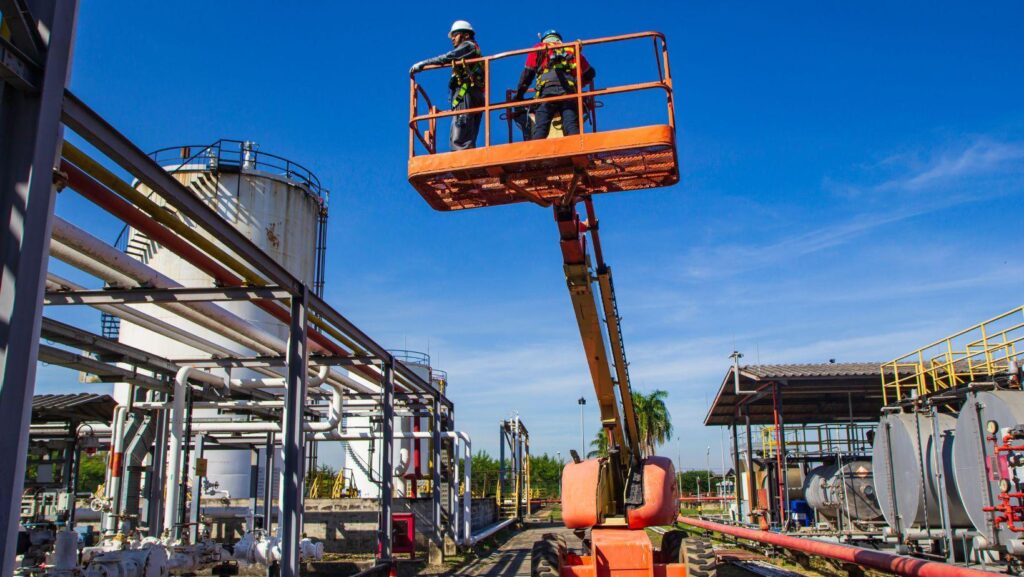
Aerial platform lift inspections get treated as a signature exercise on plenty of sites, which is a shame, because the daily check is the only one an operator controls and the only one that catches yesterday’s damage before today’s work.
It also gets confused with two other inspections that are somebody else’s job entirely. Sorting that out first makes the daily routine much easier to take seriously.
Three Inspections, Only One of Them Yours
|
Inspection |
Who does it |
When |
|
Pre-start or daily |
The operator, before use |
Every work shift |
|
Frequent |
A qualified person |
Commonly every three months or 150 hours of use |
|
Annual |
A qualified person |
Within thirteen months of the previous one |
The frequent and annual inspections look for wear, deterioration, and compliance. The daily one looks for something narrower and more urgent: what has changed since the machine last worked.
What the Daily Check Is Really Asking
Machines do not usually fail without warning. They leak, they chafe, they lose a fastener, they collect a dent nobody reported.
So the operator is not carrying out an engineering assessment. They are asking three simple questions. Has anything changed? Is anything missing? Does everything still do what it should?
That framing turns a checklist into a habit rather than a chore, and habits survive wet mornings and tight programmes in a way that paperwork does not.
The Walk Around
Start with the machine cold and still, and work in the same order every day so nothing gets skipped.
- Underneath and around the chassis: fluid on the ground, tires and wheel fasteners, damage to the outrigger boxes and pads. Fluid levels get checked here too, along with anything hanging loose.
- The structure: boom sections for dents, cracked paint that could hide something worse, pins and retainers in place, wear pads, hoses and cables routed properly rather than rubbing.
- The basket: gate closing and latching, floor and rails secure, anchor points sound, no loose tools left in it overnight.
- The information: data plate and load chart present and legible, decals readable, manuals on board. Anyone hiring an aerial platform lift should treat missing documentation as a defect rather than a detail, because the machine cannot legally be operated without it.
Testing What an Aerial Platform Lift Does, Not Just How It Looks
The second half matters as much and takes less time. With the machine set up safely at low level, run everything.
Both control stations: ground and basket. All boom functions through their range. Emergency stop at each position. Emergency lowering is actually operated rather than pointed at. Horn, beacons, and any interlocks the machine uses to enforce its envelope.
A control that feels different from yesterday is worth stopping for. Operators know their machines, and that familiarity is a genuine safety device.
Finding Something Is a Success, Not a Problem
This is where daily checks live or die culturally.
A fault found on the ground costs an hour. The same fault found at height costs a rescue. If something is wrong, the machine comes out of service, gets tagged so nobody else starts it, and the fault is reported to whoever can authorize a repair.
Nobody should feel that finding a defect was unhelpful. The alternative is a machine that failed while somebody was in the basket.
Write It Down
Records serve three purposes: they prove the check happened, they show patterns over time, and they support the machine’s value at resale.
A dated record naming the machine, the operator, and anything found takes two minutes. A run of them tells a story that a workshop and a future buyer will both read, and a gap in that run is exactly what an inspector notices first.
Ten Minutes That Protect the Whole Day
The daily inspection is small, repetitive, and easy to skip, which is exactly why it matters. Walk the machine in the same order, test every function including the ones you hope never to use, treat a missing load chart as seriously as a hydraulic leak, and record what you found. Suppliers such as Blade Platforms hand over machines with the documentation and inspection history in place, so start from that baseline and keep the daily record running from the first morning of the hire.