
Table of Contents
ToggleRelocating is statistically one of life’s most significant stressors, yet it is rarely treated with the rigorous project management it requires. While the average person moves 11.7 times in a lifetime, most approach these transitions with an ad-hoc, reactive mindset. By shifting your perspective from “packing boxes” to “managing a complex asset transition,” you can transform a chaotic ordeal into a streamlined professional operation. This guide provides the strategic framework necessary to mitigate risk, optimize your real estate investments, and maintain productivity throughout your move.
Shifting the Mindset: Moving as a Managed System
Reducing the “Cognitive Load” of Relocation
The stress of relocation often stems from “decision fatigue”—the accumulation of thousands of micro-decisions regarding logistics, finances, and lifestyle. To minimize this cognitive load, you must categorize your relocation into distinct, manageable systems. Rather than viewing the move as a singular, overwhelming task, break it down into modular phases: financial foundation, neighborhood research, transactional logistics, and operational execution. By utilizing this systematic approach, you externalize the project management burden, allowing you to focus on the high-level decisions that directly impact your ROI and peace of mind.
Why the Traditional Moving Checklist Fails Homeowners
Standard moving checklists are typically linear and superficial, focusing on packing tips rather than risk mitigation. They fail to account for the unique complexities of a modern home purchase, such as equity leverage, digital infrastructure, or the nuances of the real estate market. A true relocation strategy acknowledges that every move is a financial transaction. If your checklist does not include a contingency for market volatility or a plan for smart-home integration, it is insufficient for a professional-grade relocation.
Creating Your Relocation Decision Matrix: Must-Haves vs. Nice-to-Haves
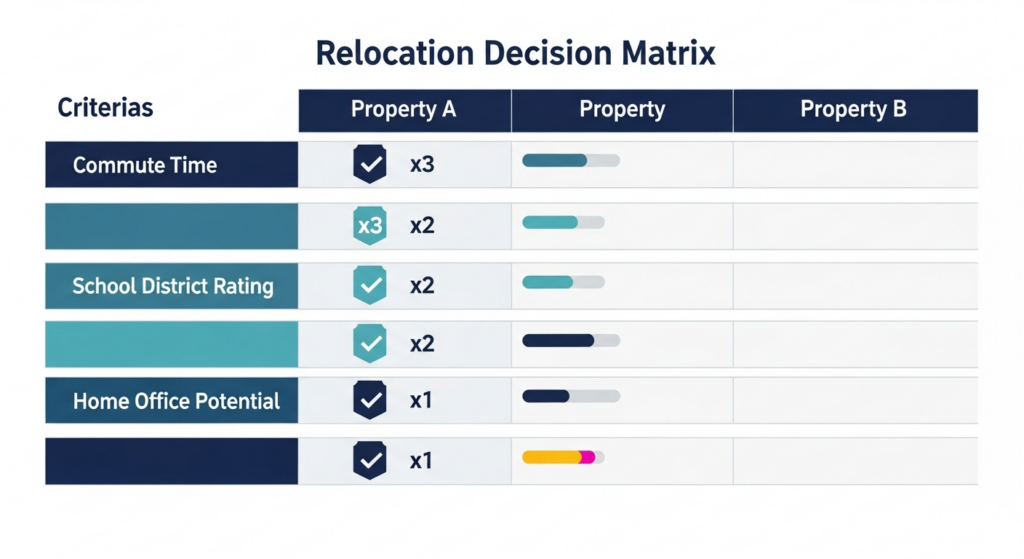
A Relocation Decision Matrix helps you objectively score potential homes based on weighted priorities, removing emotion from the buying process.
Before contacting real estate agents or listing your current property, establish a formal Decision Matrix. Create a spreadsheet listing your non-negotiables—such as commute time, school district rating, or home office potential—against your preferences. Assign a weight to each variable. This objective framework prevents emotional decision-making when you are deep in a high-stakes contract negotiation, ensuring your new home aligns with your long-term goals.
Phase 1: The Strategic Financial Foundation
Leveraging Home Equity for Your Next Purchase
As a homeowner, your existing property is a primary capital asset. Before moving, evaluate your home equity and determine how it will be deployed. Will you utilize a bridge loan, or must you time the sale of your current home to provide liquidity for the next? Aligning your financial strategy with the prevailing interest rate environment is critical to maintaining a healthy debt-to-income ratio during this transition.
Comprehensive Budget Management: Moving Expenses and Hidden Costs
Relocation costs extend far beyond the moving company invoice. Factor in professional staging, potential lease-gap rent, closing costs, and utility overlap fees. Create a “Relocation Contingency Fund” specifically for unexpected repairs in your new home. By accounting for these hidden costs, you protect your broader financial stability.
Navigating the Career Move: Networking and Professional Transitions
If your relocation is tied to a career change, synchronize your move timeline with your professional onboarding. Use your network to gain local insight before you arrive. Understanding the local employment landscape can provide clarity on your long-term earning potential in the new area, which should inform the maximum price point of your next home purchase.
Timing the Market: The “Buy First vs. Sell First” Dilemma
Deciding whether to buy or sell first is the most significant tactical decision you will make. In a hot real estate market, buying first may be necessary to secure a property, but it carries higher risk. Selling first ensures liquidity but requires temporary housing. Consult with experienced local real estate agents to evaluate local inventory levels and demand trends before committing to a sequence.
Phase 2: Hyper-Local Due Diligence and Neighborhood Research
Understanding HOA Structures and Community Amenities
Homeowners Associations (HOAs) can significantly impact your lifestyle and property value. Review CC&Rs (Covenants, Conditions, and Restrictions) before signing a contract. Are the amenities functional, or are they under-maintained liabilities? Understanding these structures prevents unpleasant surprises regarding monthly fees or restrictions on property modifications.
Evaluating Public Schools and Community Infrastructure
Even if you do not have school-aged children, school district quality is a leading indicator of long-term property appreciation. Beyond education, examine the community infrastructure. Are there reliable transportation corridors, robust healthcare facilities, and consistent maintenance of local public spaces? These factors directly dictate the desirability and future liquidity of your investment.
Environmental Factors: Flood Zones, Climate, and Insurance Premiums
Environmental risk is increasingly critical to real estate valuation. Verify the flood zone status and climate risks (such as wildfire or wind exposure) for any prospective property. Consult with an insurance provider to estimate premiums early; significant insurance hikes can drastically alter your monthly mortgage payment and should be factored into your total cost of ownership.
Digital Infrastructure: Comparing Fiber vs. 5G Home Internet Availability
In the modern economy, digital connectivity is as essential as water and power. During your due diligence, verify the internet service provider (ISP) options at the property address. Confirm whether high-speed fiber or reliable 5G home internet is available. A home without stable, high-speed connectivity is a significant disadvantage for remote professionals and impacts future resale potential.
Phase 3: The Real Estate Transaction and Logistics
Partnering with the Right Real Estate Agents for a Multi-City Move
For a relocation involving a move between different cities, interview real estate agents who specialize in corporate or long-distance relocation. Look for agents who act as project managers—those capable of coordinating virtual tours, local inspection referrals, and contract oversight while you are managing your existing responsibilities.
Pricing Strategy and Online Marketing for Your Current Home Listing
Your current home is a product that must be positioned to sell quickly and at maximum value. Work with your agent to analyze the current real estate market, focusing on recent comparable sales. Utilize professional photography and targeted digital marketing to ensure your property reaches the right buyer demographic, reducing the duration your capital remains tied up in the asset.
Mastering Negotiation Strategies and Contingency Plans
Negotiations are the most volatile phase of the real estate process. Maintain a clear, written strategy for your contingencies—specifically inspection, appraisal, and financing. Understand your “walk-away” price and remain disciplined. Never allow emotions to override the objective facts established in your Decision Matrix.
Managing Real Estate Papers and the Closing Day Timeline
Closing day requires precise coordination. Use a secure digital vault to manage your real estate papers, ensuring that all contracts, disclosures, and insurance documents are readily accessible. Coordinate your move-out and move-in dates with the specific closing times for both transactions to avoid unnecessary storage costs or transitional lodging.
Phase 4: Operational Execution and Decluttering
The Art of Inventorying: Categorizing Household Items for ROI
Inventorying is not just about keeping track of belongings; it is about cost-efficiency. Categorize items by weight, volume, and necessity. If the cost to move an item exceeds its replacement value, the correct decision is to sell or donate it. This reduces the moving company quote and simplifies your arrival at the new residence.
Decluttering for a Better Listing and a Lighter Move
Decluttering serves a dual purpose: it prepares your home for potential buyers by creating an aesthetic of spaciousness, and it lowers your shipping costs. Approach this phase with an “asset-light” mindset. The less you move, the faster you can set up your new home, and the lower your physical and logistical overhead will be during the move.
Choosing Professional Movers: White-Glove Service vs. Standard Transport
Evaluate the scope of your move. Does it require white-glove service, where professionals pack and unpack every item, or is a standard transport service sufficient? Balance your budget against the value of your time. For busy homeowners, the cost of full-service packing is often offset by the reduction in personal labor and downtime.
According to practical relocation insights from Pick and Pack Moving Company, investing in full-service execution bridges the gap between leaving your old house and comfortably settling into your new property, without sacrificing business productivity or personal peace of mind.
Securing Moving Estimates and Understanding Insurance Coverage
Obtain at least three detailed moving estimates. Ensure these quotes are “binding” to avoid price creep. Crucially, review the moving company’s insurance coverage. Standard liability is often insufficient for high-value items; verify that you have adequate transit insurance to cover your belongings during the move.
Phase 5: The Tech-Driven Utility Transition
Utilizing a Utility Concierge Service for a Seamless Handover
Modern relocations are streamlined by utility concierge services that aggregate the transfer of electricity, water, and internet into a single platform. These services automate the handoff, ensuring that services remain uninterrupted during your transition, which is vital for maintaining productivity and home security.
The Utilities Checklist: Electricity, Water, and Smart Home Transfers
Create a rigorous utilities checklist. Beyond the basics like electricity and water, include the transfer of smart home accounts, Wi-Fi mesh networks, and automated thermostats. Managing these technical transfers in advance ensures your home is functional the moment you walk through the door.
USPS Change of Address and Identity Security
Identity security is paramount during a move. Initiate the USPS change-of-address process well in advance, but also manually update your financial, tax, and insurance accounts to ensure no sensitive mail is intercepted. Use a secure, encrypted password manager to track these updates throughout your move.
Managing Smart Security Systems During the Transition
Your home security system should be the last thing you deactivate in the old house and the first thing you activate in the new one. Coordinate with your service provider to ensure a seamless handoff of cameras, smart locks, and alarm monitoring. This prevents any lapse in surveillance, keeping your property secure throughout the handover.
Conclusion
Relocating successfully is the result of deliberate planning, disciplined decision-making, and high-level project management. By treating your relocation as a structured system rather than a series of chores, you mitigate financial risk, protect your time, and ensure a seamless integration into your new community.
To recap, your success depends on three pillars: maintaining a rigid financial and logistical matrix, prioritizing digital and physical due diligence, and utilizing professional services to manage the heavy lifting. As you prepare for your next move, start by auditing your current assets and applying the decision-making framework outlined here. If you act with precision, the transition will not only be stress-free but also a foundational step toward your next chapter of growth and stability. Begin your preparations today by documenting your requirements and scheduling your professional consultations—your future, more efficient self will appreciate the investment.